
SKI-S01 / Sustainable system / Energy storage
Eco-Volt: a plant-based sodium-ion bio-cell with a photo-assisted charging concept.
A plant-based bio-cell concept combining abundant sodium chemistry, bio-derived materials and a proposed self-charging pathway.
01 / THE CHALLENGE
Energy storage must reduce both material risk and resource dependence.
Conventional lithium-ion systems depend on constrained materials and require careful safety management. Eco-Volt explores a lower-toxicity, more biodegradable material set alongside a light-assisted charging mechanism.
02 / THE SYSTEM
Electrochemistry and photo-assistance in one conceptual cell.
The proposed architecture uses a lignin-carbon anode, NaFePO₄ cathode, CMC binder and alginate-based electrolyte. Carbon dots and glucose-mediated electron donation are investigated as the basis of a photo-assisted self-charging mechanism. Earlier public material that referred to a “Plant-Based Bio-Cell” has been consolidated here because both descriptions referred to the same core project.
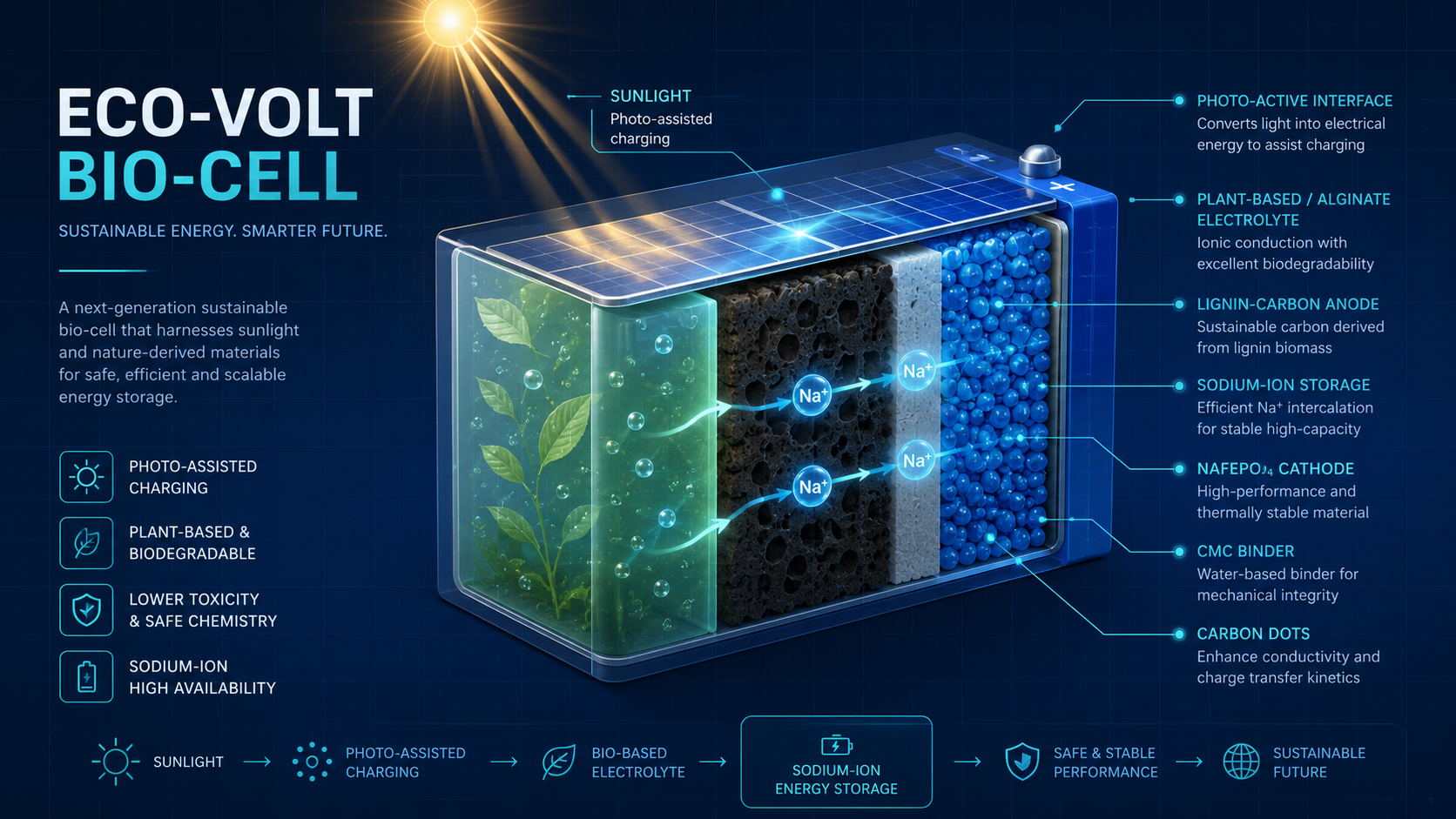
03 / SYSTEM LOGIC
From requirement
to controlled output.
The project is organised as an explicit operating sequence rather than a collection of disconnected features.
CAPABILITIES / WORK SCOPE
What the system contains.
- 01Lignin-carbon anode concept
- 02NaFePO₄ cathode
- 03CMC binder
- 04Alginate-based electrolyte
- 05Carbon-dot photo-assistance
- 06Glucose-mediated electron donation
- 07Sodium-ion material pathway
- 08Biodegradability and safety focus
- 09Plant-derived material pathway
- 10Merged public project representation
04 / OUTCOME
A competition-recognised research concept proposing a more resource-abundant and environmentally considerate direction for small-scale energy storage.
Electrochemical performance and self-charging behaviour require controlled laboratory validation.